
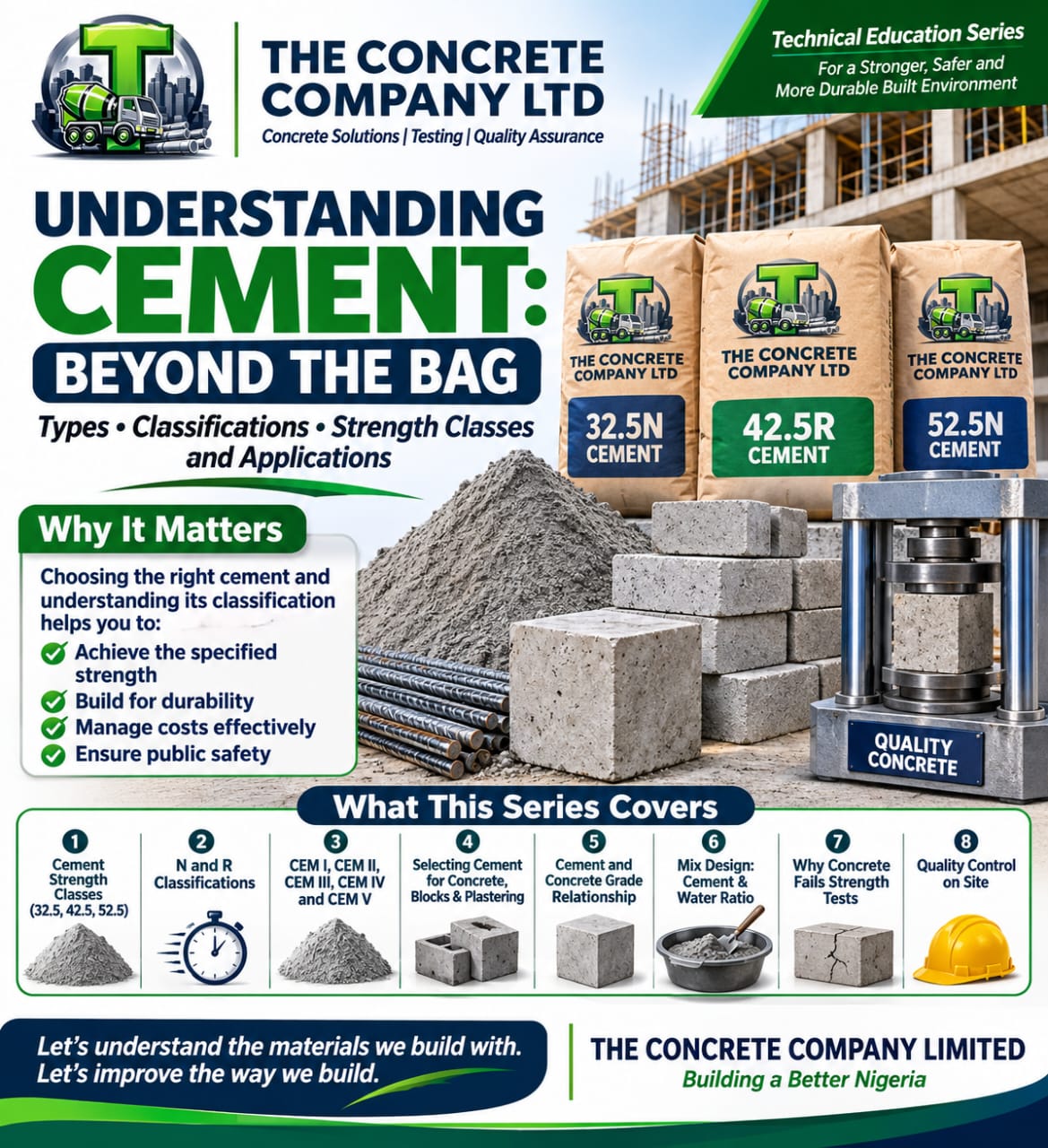
UNDERSTANDING CEMENT: BEYOND THE BAG – A TECHNICAL EDUCATION SERIES
Why should every construction professional understand the cement they use?
Cement is one of the most widely used materials in the construction industry. Yet, how much do we really understand about the different types, classifications, strength classes and their appropriate applications?
When you visit a building site or a building-materials market in Nigeria, you will encounter cement labelled 32.5N, 42.5N, 42.5R, CEM I, CEM II and other classifications.
But what do these markings actually mean?
Is 42.5 cement necessarily better than 32.5 cement?
Does 42.5R mean faster setting?
Can 32.5N cement produce Grade 25 or Grade 30 concrete?
Are all cement types suitable for reinforced concrete, block manufacturing, plastering and masonry?
These are not merely academic questions. They have practical implications for structural performance, construction quality, durability, cost management and ultimately, public safety.
INTRODUCING THE CONCRETE TECHNOLOGY EDUCATION SERIES
The Concrete Company Limited (TCCL) is introducing an educational series designed to improve understanding of cement technology and its practical applications in the Nigerian construction industry.
Through this series, we will examine:
1. Cement strength classes: 32.5, 42.5 and 52.5.
2. Understanding N and R classifications.
3. CEM I, CEM II, CEM III, CEM IV and CEM V.
4. Selecting cement for concrete casting, block making, plastering and masonry.
5. The relationship between cement strength class and concrete grade.
6. Cement, water-cement ratio and concrete mix design.
7. Why concrete sometimes fails compressive-strength tests.
8. Cement quality control and best practices on construction sites.
We will go beyond definitions.
Our discussions will include practical examples, mix-design calculations, site scenarios, laboratory testing and quality assurance procedures.
OUR POSITION
At The Concrete Company Limited, we believe that quality concrete begins with knowledge, proper material selection, controlled production, competent placement and effective quality assurance.
We want to encourage a construction culture where materials are selected based on technical suitability rather than assumptions, and where quality is demonstrated through testing rather than claims.
Whether you are a civil engineer, builder, architect, contractor, block manufacturer, site supervisor, student or construction enthusiast, this series is for you.
Let's understand the materials we build with. Let's improve the way we build.
THE CONCRETE COMPANY LIMITED
Concrete Solutions | Testing | Quality Assurance & Quality Control
#TheConcreteCompanyLimited #CementTechnology #ConcreteTechnology #ConstructionEngineering #ConcreteQAQC #BuildingTechnology #ConstructionQuality #NigeriaConstruction