From Green to Guru — Episode 1
Graduating from engineering school is an achievement.
But graduation is not the end of engineering education. In many ways, it is the beginning.
A young engineer may have studied structural analysis, reinforced concrete design, soil mechanics, surveying, hydraulics, construction technology and engineering mathematics. He or she may have passed examinations and obtained a degree.
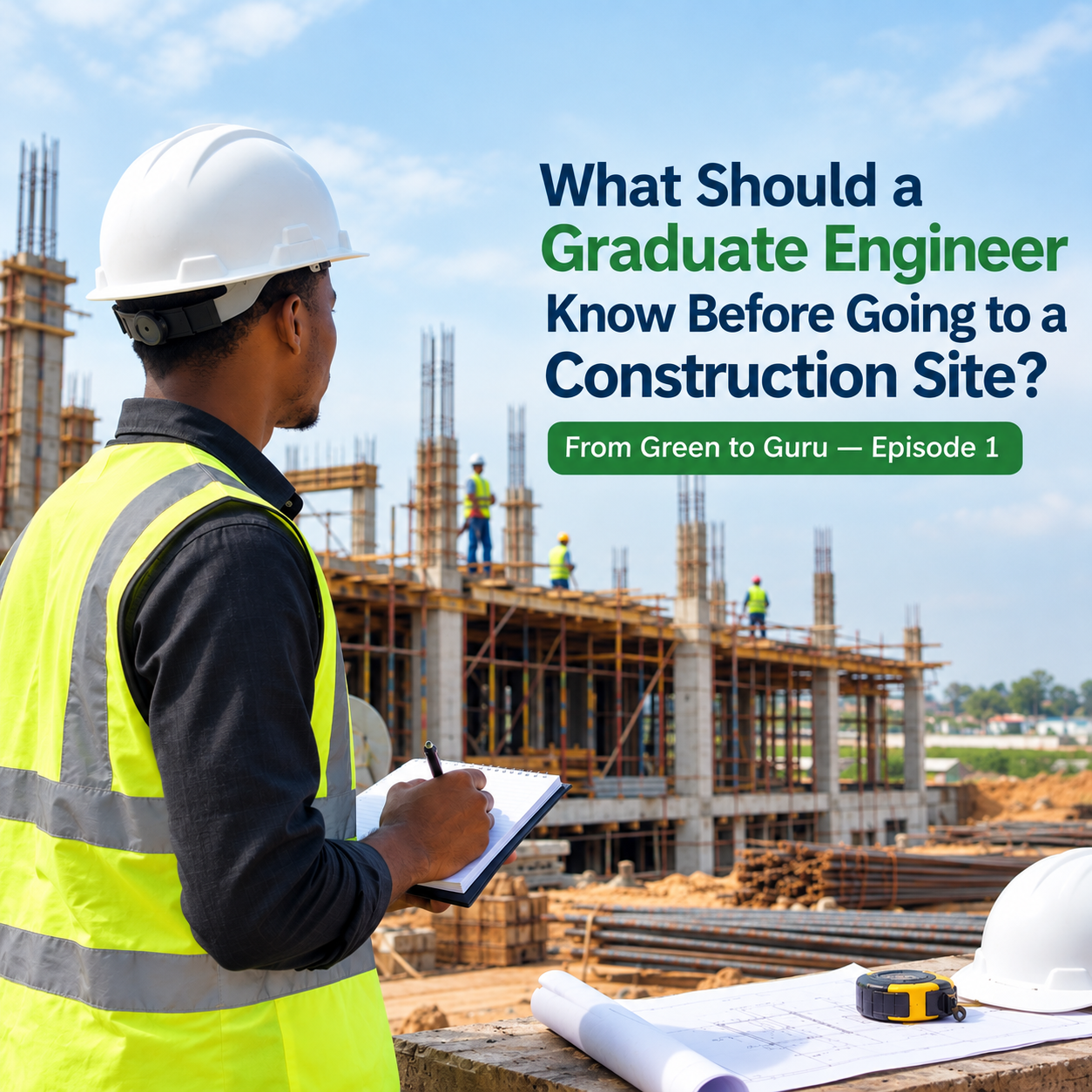
Then comes the first day on a real construction site.
Suddenly, the questions are different.
Where is the benchmark?
How do I know that this column is in the correct position?
Why are these reinforcement bars placed at the bottom of the beam?
Why are the stirrups closer together near the support?
What should I check before concrete is poured?
How do I know that the concrete delivered to site is acceptable?
What exactly should I record in my site diary?
What do I do when what is being constructed does not appear to agree with the drawing?
These are not merely academic questions.
They are part of the everyday practice of engineering.
At Engineering Resource Academy (ERA), we believe that developing a competent engineer requires more than classroom knowledge. A young engineer must learn how to observe, interpret, measure, verify, document, communicate and make sound engineering decisions.
That is the journey from Green to Guru.
1. Understand the Difference Between Engineering School and Engineering Practice
Engineering school teaches you principles.
The construction site teaches you how those principles behave in the real world.
At school, you may calculate the required reinforcement for a beam.
On site, you must be able to identify that beam on a drawing, locate it physically, understand its reinforcement arrangement, check the bar diameter and spacing, verify the formwork and ensure that the work is ready before concrete is placed.
The calculation is important.
But the ability to ensure that the calculated design is correctly translated into physical construction is equally important.
This is why a graduate engineer should never think:
«"I have graduated, therefore I already know engineering."»
A better mindset is:
«"I have acquired the foundation. Now I must learn how to apply it."»
2. Learn to Read Drawings Before You Learn to Supervise Construction
One of the first skills a young engineer should develop is the ability to read drawings systematically.
You should be comfortable with:
- Architectural drawings
- Structural drawings
- Foundation layouts
- Column layouts
- Beam layouts
- Slab reinforcement drawings
- Reinforcement details
- Sections and elevations
- Schedules
- Bar Bending Schedules (BBS)
- General notes
- Levels and dimensions
Do not simply look at a drawing.
Learn to interrogate it.
For example, if you are given a beam drawing, you should be able to identify:
- Beam reference
- Beam size
- Span
- Support conditions
- Main reinforcement
- Top reinforcement
- Bottom reinforcement
- Links/stirrups
- Link diameter
- Link spacing
- Anchorage
- Laps
- Concrete cover
- Construction joints, where applicable
- Relevant levels
A good site engineer does not wait until a problem occurs before opening the drawing.
The drawing should be one of the engineer's primary working tools.
3. Understand Setting Out
A building can have excellent concrete, excellent reinforcement and excellent workmanship and still be wrong if it has been constructed in the wrong position.
That is why setting out matters.
A young engineer should understand the relationship between:
Drawing → Coordinates/Grid → Benchmark → Setting Out → Physical Construction
You should understand basic concepts such as:
- Grid lines
- Coordinates
- Reduced levels
- Benchmarks
- Datums
- Offsets
- Centre lines
- Building lines
- Right angles
- Level checks
You should also understand the basic operation and purpose of instruments such as:
- Automatic level
- Laser level
- Total station
- Measuring tape
- Staff
You do not necessarily have to become a professional surveyor, but a site engineer must understand enough surveying to recognise whether setting-out information makes sense and to work effectively with the survey team.
4. Understand What Happens During Foundation Construction
A young engineer should know the sequence of foundation construction.
For a typical reinforced concrete foundation, this may involve:
1. Setting out
2. Excavation
3. Inspection of formation level
4. Soil/ground condition verification
5. Blinding, where specified
6. Reinforcement fixing
7. Formwork, where required
8. Inspection
9. Concrete placement
10. Curing
11. Subsequent foundation operations
For piled foundations, the sequence becomes more involved.
The engineer needs to understand activities such as:
- Pile setting out
- Pile installation
- Pile integrity/testing requirements
- Pile trimming
- Pile head preparation
- Pile-cap construction
- Ground beams/connecting beams
- Reinforcement continuity and anchorage
- Concrete placement
- Backfilling, where appropriate
The important point is not simply memorising the sequence.
Understand why each operation is being performed.
5. Learn Reinforcement Properly
Reinforcement is one of the areas where a young engineer can quickly distinguish between theoretical knowledge and practical competence.
You should be able to identify reinforcement by:
- Diameter
- Bar mark
- Shape
- Spacing
- Position
- Length
- Anchorage
- Lap arrangement
You should understand the difference between:
- Main bars
- Distribution bars
- Links/stirrups
- Ties
- Chairs
- Starter bars
- Dowels
You should also understand why reinforcement is positioned where it is.
For example, do not merely memorise:
«"Beam bottom bars go at the bottom."»
Understand the structural reason.
In a typical simply supported beam under gravity loading, the lower region of the span is generally where flexural tension develops, so the main tensile reinforcement is placed toward the bottom of the beam.
Similarly, near supports in continuous beams, hogging moments can produce tension toward the top, which is why appropriate top reinforcement is required.
Never memorise reinforcement details without understanding the structural behaviour behind them.
6. Understand Formwork
Formwork is not simply timber, plywood or steel arranged to hold concrete.
It is a temporary structural system that must safely resist construction loads and maintain the required geometry until the concrete has developed sufficient capacity.
A young engineer should understand:
- Formwork dimensions
- Line
- Level
- Plumb
- Stability
- Props
- Bracing
- Supports
- Joints
- Openings
- Beam depths
- Slab thickness
- Column dimensions
- Release agents
- Cleaning before concrete placement
Before a concrete pour, the engineer should be asking:
Is the formwork in the correct position, at the correct level, of the correct dimensions and adequately supported?
7. Understand Concrete — Not Just Concrete Grade
Knowing that a project specifies C25/30 or another concrete strength class is not enough.
A young engineer should understand the entire concrete process:
Materials → Batching → Mixing → Transportation → Placing → Compaction → Finishing → Curing
You should understand:
- Cement
- Aggregates
- Water
- Admixtures
- Water-cement ratio
- Workability
- Slump
- Segregation
- Bleeding
- Compaction
- Curing
- Concrete strength
You should also understand the purpose of the common site tests associated with concrete.
For example, the slump test provides an indication of concrete consistency/workability. It does not, by itself, prove that the concrete has achieved the specified compressive strength.
Likewise, a concrete cube test is not simply a ritual performed because "that is what engineers do."
It is part of a broader quality-control process used to assess compressive strength of sampled concrete.
The young engineer should understand what is being tested, how the sample is taken, how specimens are prepared and cured, what the results mean, and what action may be required when results do not meet the specified acceptance criteria.
8. Learn Quality Assurance and Quality Control
This is one of the most important areas for a young engineer.
QA/QC is not about looking for mistakes after the work has been completed.
The objective is to establish a controlled process that helps ensure the work conforms to the drawings, specifications, standards and approved procedures.
A young engineer should become familiar with:
- Inspection and Test Plans (ITPs)
- Inspection requests
- Checklists
- Method statements
- Material approvals
- Test certificates
- Concrete test records
- Reinforcement inspection
- Formwork inspection
- Non-conformance reports
- Corrective actions
- Site records
Before concrete is poured, for example, the engineer should not simply ask:
«"Are we ready to pour?"»
The better question is:
«"Has every critical item required for this pour been inspected and verified?"»
That change in mindset is important.
9. Learn to Measure
Engineering is a quantitative profession.
A young engineer should become comfortable measuring:
- Length
- Width
- Height
- Depth
- Area
- Volume
- Levels
- Quantities
- Reinforcement spacing
- Concrete quantities
You should understand basic construction measurements such as:
Concrete volume = Length × Width × Depth
For example, a slab measuring 10 m × 8 m with a thickness of 150 mm:
150 mm = 0.15 m
Volume:
10 × 8 × 0.15 = 12 m³
This may appear elementary.
But understanding quantities is fundamental to:
- Estimating
- Procurement
- Cost control
- Material reconciliation
- Construction planning
- Payment certification
- Productivity monitoring
A good engineer should be comfortable moving between drawings, measurements, quantities and physical work.
10. Keep Proper Site Records
If something important happened on site but there is no reliable record of it, problems can arise later.
Young engineers should learn to document:
- Date
- Weather conditions where relevant
- Manpower
- Activities undertaken
- Materials received
- Equipment used
- Inspections
- Tests
- Concrete pours
- Delays
- Instructions
- Variations
- Incidents
- Visitors/meetings where relevant
- Problems encountered
- Actions taken
A site diary is not merely a notebook.
It is part of the project's technical and contractual record.
If you inspect it, measure it, test it, approve it, reject it or instruct it, understand what should be documented.
11. Learn to Communicate With People on Site
Engineering is technical.
Construction is also human.
A young engineer will interact with:
- Artisans
- Foremen
- Supervisors
- Contractors
- Subcontractors
- Surveyors
- Quantity surveyors
- Architects
- Structural engineers
- MEP engineers
- Project managers
- Clients
- Suppliers
You therefore need more than technical knowledge.
You need communication skills.
Learn how to:
- Give clear instructions
- Ask precise questions
- Listen
- Report problems
- Explain technical requirements
- Challenge incorrect work professionally
- Escalate serious issues appropriately
- Record important instructions
Never confuse being aggressive with being authoritative.
A competent engineer should be able to say:
«"This work does not appear to comply with the drawing. Let's verify the requirement before proceeding."»
That is professional engineering communication.
12. Develop the Habit of Verification
One of the most dangerous habits for a young engineer is assuming that something is correct simply because somebody says it is correct.
A contractor may say:
«"The reinforcement is correct."»
Verify it.
Someone may say:
«"The concrete is M25."»
Check the documentation and the specified requirements.
Someone may say:
«"The column is in the right position."»
Check the setting-out information.
Someone may say:
«"The level is correct."»
Take the appropriate measurement.
Engineering requires a culture of verification.
The principle is simple:
Do not guess when you can measure.
13. Understand Health and Safety
No engineering achievement justifies unnecessary exposure to danger.
A young engineer should understand basic construction-site safety requirements, including:
- Personal protective equipment
- Working at height
- Excavation safety
- Electrical hazards
- Lifting operations
- Plant and equipment
- Traffic management
- Housekeeping
- Temporary works
- Emergency procedures
You should also understand that PPE is not a substitute for proper hazard control.
The engineer must learn to recognise hazards and understand the control measures established for the work.
14. Learn to Use Engineering Software — But Don't Become Dependent on It
Modern engineers need digital skills.
At minimum, a young civil/construction engineer should progressively develop competence in tools such as:
- Microsoft Excel
- AutoCAD
- Microsoft Project and/or Primavera P6
- Revit, where relevant
- Structural analysis/design software appropriate to their discipline
- Power BI and other data tools as their career develops
But remember:
Software should support engineering judgment, not replace it.
If you cannot explain what a software package is calculating, what assumptions are being made and whether the result makes engineering sense, then you have not yet mastered the engineering.
15. Learn the Standards That Govern Your Work
A professional engineer cannot rely solely on what someone says is "normal practice."
You need to know which standards and project specifications apply to the work.
Depending on the project and discipline, this may involve standards such as:
- British Standards
- Eurocodes
- Nigerian Standards
- Project specifications
- Manufacturer's technical documentation
- Approved drawings
- Contract requirements
- Relevant statutory requirements
The important skill is not memorising every clause.
It is learning where to find the requirement and how to interpret it correctly.
16. Ask Questions — But Ask Intelligent Questions
There is nothing wrong with being a beginner.
There is something wrong with pretending not to be one.
A young engineer should ask questions.
But instead of asking:
«"Why are you doing this?"»
try to understand the issue first and ask:
«"I noticed that the drawing shows 150 mm spacing here but the bars are currently at 200 mm. Is there an approved revision or instruction that changes this requirement?"»
That demonstrates observation.
The objective is not to prove that you know everything.
The objective is to learn how to think like an engineer.
17. The First 30 Things a Graduate Engineer Should Learn
Before a young engineer considers himself or herself competent on site, these are some of the areas worth mastering:
1. Reading architectural drawings
2. Reading structural drawings
3. Understanding grid lines
4. Understanding levels
5. Basic setting out
6. Basic surveying
7. Foundation construction
8. Reinforcement identification
9. Bar spacing
10. Concrete cover
11. Bar laps and anchorage
12. Bar Bending Schedules
13. Formwork inspection
14. Concrete batching
15. Concrete placing
16. Concrete compaction
17. Concrete curing
18. Slump testing
19. Cube sampling/testing
20. Construction joints
21. Basic quantity measurement
22. Site diary preparation
23. Inspection checklists
24. QA/QC procedures
25. Method statements
26. Health and safety
27. Construction sequencing
28. Basic planning and scheduling
29. Technical communication
30. Engineering ethics and professional responsibility
This is not the end of the learning journey.
It is the beginning.
The Engineer You Should Aim to Become
A competent engineer is not simply the person who can solve a difficult equation.
It is the person who can move confidently between:
Drawing → Calculation → Measurement → Materials → Workmanship → Inspection → Documentation → Decision
That is where engineering theory becomes engineering practice.
The young engineer who learns this early will develop faster than one who spends years simply following instructions without understanding why the work is being done.
At Engineering Resource Academy, our goal is therefore not simply to expose young engineers to construction sites.
Our goal is to help them develop competence.
To observe.
To question.
To measure.
To verify.
To document.
To communicate.
To learn from experienced professionals.
And eventually, to make sound engineering decisions independently.
That is the journey:
From Green to Guru
About Engineering Resource Academy
Engineering Resource Academy (ERA) is committed to developing practical engineering competence through structured training, practical exposure, mentorship and continuous professional development.
Our programmes are designed to help young engineers bridge the gap between what they learn and what they are expected to do in the real world.
Whether you are an engineering student, graduate engineer, young professional or experienced engineer seeking to strengthen your practical competence, the learning journey continues.
Engineering is not learned once. It is developed through continuous learning, practice and experience.